






Here's what we'll cover
The short answer: from about October to March, the sun in the UK is too low in the sky for your skin to make vitamin D, so the NHS advises most people take a 10 microgram (400 IU) supplement daily through those months. Some groups are advised to take it all year. This is one of the few supplement recommendations that applies to nearly everyone here.
What does vitamin D do?
Vitamin D helps the body absorb calcium and phosphate from food, which keeps bones, teeth and muscles healthy. A serious lack causes rickets in children and bone pain and weakness (osteomalacia) in adults. It is unusual among vitamins because your skin makes most of it from sunlight rather than food.
Claims beyond bone and muscle health, from immunity to mood, are heavily researched but far less certain. Trials of vitamin D supplements in people who already have adequate levels have mostly been disappointing, which is worth remembering when a product promises more.
Why latitude matters
Your skin makes vitamin D when ultraviolet B light hits it. In the UK's northern latitude, sunlight strong enough for this reaches us only from roughly late March to late September. In the darker half of the year the body relies on stores built up over summer plus whatever comes from food, and food sources are limited, mainly oily fish, egg yolks and fortified products.
That seasonal gap is why the guidance is time-limited for most people rather than year-round: it targets the months when your skin simply cannot produce enough. The advice comes from the Scientific Advisory Committee on Nutrition, whose 2016 review of vitamin D and health underpins the 10 microgram recommendation.
Which foods contain vitamin D?
Vitamin D foods are a short list. Oily fish such as salmon, sardines, mackerel and herring are the best sources; egg yolks, red meat and liver contribute smaller amounts. Some foods are fortified, including most fat spreads, some breakfast cereals and some plant-based milk alternatives, though unlike some countries the UK does not fortify cow's milk as standard.
In practice it is difficult to reach 10 micrograms a day reliably from diet alone unless you eat oily fish often, which is why the UK advice reaches for a supplement rather than a food list. Diet still matters: it tops up stores and covers part of the requirement year-round. If you are deciding whether you need any other supplements, vitamin D is the exception rather than the template: most other nutrients are covered by a varied diet.
Who is advised to supplement all year
Some groups are advised by the NHS to take vitamin D throughout the year, because they make little regardless of season:
- People who are rarely outdoors, for example those who are housebound or in care.
- People who usually cover most of their skin when outside.
- People with darker skin, from African, African-Caribbean or south Asian backgrounds, who make less vitamin D from the same sunlight.
- Infants and young children, under separate NHS guidance.
Do you need a blood test?
For most people, no. The NHS advice is preventive: take a modest daily dose in winter rather than test everyone. Testing has a role if a deficiency is suspected because of symptoms of vitamin D deficiency, a relevant medical condition, or membership of a higher-risk group, and that is a conversation for your GP, who can interpret the result and advise on dose. Buying a private finger-prick test is rarely necessary for an otherwise healthy adult.
How much, and what form
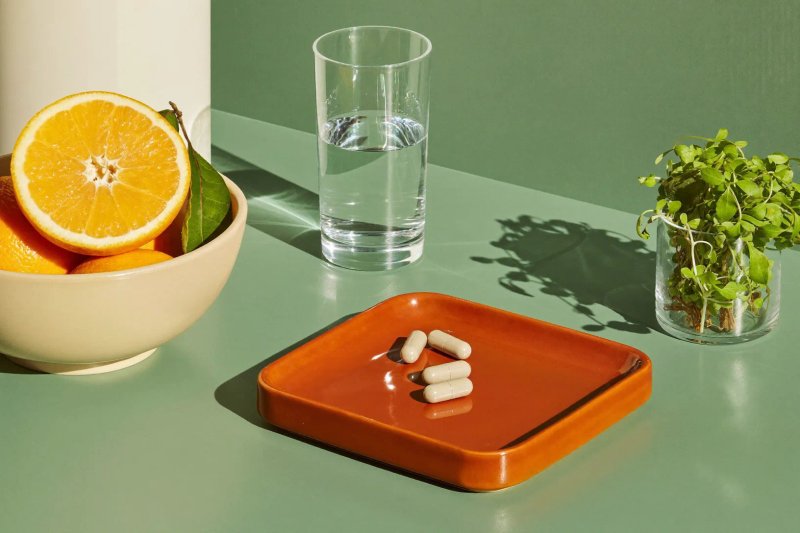
The standard supplement is 10µg (400 IU) daily. Vitamin D tablets, capsules, drops and sprays all work; no delivery format has convincing evidence of superiority, so choose whatever you will take consistently. Labels list the dose in micrograms (µg) or international units (IU), and 10µg equals 400 IU; our guide to reading supplement labels covers the units. Vitamin D is fat-soluble, so taking it with a meal that contains some fat can help absorption, though consistency matters more than timing.
Is vitamin D3 the same as vitamin D?
Essentially yes: D3 is one of the two supplement forms of vitamin D, not a different nutrient. Vitamin D comes as D2 (ergocalciferol), made by plants and fungi, or D3 (cholecalciferol), the form your skin makes from sunlight. D3 is generally considered more effective at raising and maintaining blood levels, which is why most products use it, and vegan D3 derived from lichen is now widely available. If a label just says vitamin D, check the small print, but either form counts towards the 10µg advice.
You may also see vitamin D combined with vitamin K2 or with calcium in bone-health products. For an otherwise healthy adult following the winter advice, a plain 10µg vitamin D on its own is all the guidance actually calls for; the combinations are optional and worth judging on need rather than novelty.
If your GP diagnoses a deficiency, NICE guidance sets out treatment doses that are higher and time-limited, then usually followed by a maintenance dose. That is a clinical decision, not something to self-prescribe from high-strength products online. For where timing fits in, see does supplement timing matter.
The honest bottom line
Vitamin D is the rare supplement with clear UK public-health backing, but the advice is specific: a modest dose, mostly in winter, for a real biological reason. It is not a licence to take large amounts year-round in the hope of extra benefit; the trial evidence for high-dose vitamin D preventing a broad range of illnesses in already-sufficient people is largely disappointing.